Whatsapp:+86 17852301313 Email:tinghe.lv@yimaotomg999.com


How to Find and Fix Clogged Drip Emitters (Without Replacing Your Whole System)

The easiest way to tell if an emitter is clogged
Walk your drip line while the system is running. Look at each emitter for about three seconds.
A working 1 GPH emitter will produce a slow, steady drip — about one drop every two seconds. A 2 GPH emitter will be roughly twice that. If you see a thin stream instead of drops, the emitter body is cracked and you need to replace it, not unclog it.
A partially clogged emitter still drips, but noticeably slower than its neighbors on the same line. A fully clogged one does nothing. No water, no wet spot, nothing. If the plant near it looks fine, you caught it early. If the plant is wilting while everything around it is thriving, you waited too long.
Run your finger over the emitter outlet. Sometimes you can feel a crust — that’s mineral scale. Other times the outlet looks clean but nothing comes out. That usually means the internal labyrinth is blocked, which is harder to fix.
Why your emitters clog (and which type you’re dealing with)
I’ve pulled apart hundreds of emitters over the years. The gunk inside usually falls into one of three categories.
Sediment. Sand, silt, bits of pipe shavings from installation. This is the most common cause, especially if you’re on well water or if someone did a sloppy job cutting the poly tubing and left plastic fragments inside. A 150-mesh filter (that’s 100 micron) catches most of this. If you don’t have a filter installed, or if yours has a torn screen, sediment works its way into every emitter on the line.
Mineral scale. White or tan crusty deposits — calcium and magnesium carbonates, same stuff that builds up on your showerhead. This is regional. If you have hard water, you’ll fight this constantly. Scale narrows the tiny internal passages inside pressure-compensating emitters until flow drops to near zero.
Biological gunk. Algae, bacteria slime, and sometimes tiny roots. This one’s nasty because it grows. A system that ran fine in May can be half-clogged by August. You’ll usually see green or brown film inside the tubing when you cut it open. Iron bacteria — that reddish-orange slime — is particularly common in well water and will clog emitters faster than anything else.
What you need before you start
Gather this stuff before you touch anything. There’s nothing worse than cutting a line and realizing you’re missing a coupling.
- Goof plugs (also called figure-8 plugs or hole plugs). Get the brand that matches your tubing — Rain Bird plugs fit Rain Bird tubing better than generic ones. You’ll need these to seal holes when you pull out bad emitters.
- Replacement emitters. Match the flow rate (0.5, 1, or 2 GPH) and brand of your existing ones. Pressure-compensating emitters from different brands have different barb sizes, and mixing them causes leaks.
- An emitter punch tool. Not a nail, not a drill bit. The $8 punch tool makes a clean hole. A nail tears the tubing and the hole won’t seal around the new emitter barb.
- White vinegar for mineral scale, or hydrogen peroxide (3% solution, the drugstore kind) for biological gunk.
- A small bucket or cup for soaking emitters.
- End caps or flush valves. You’ll need to open the end of each line to flush.
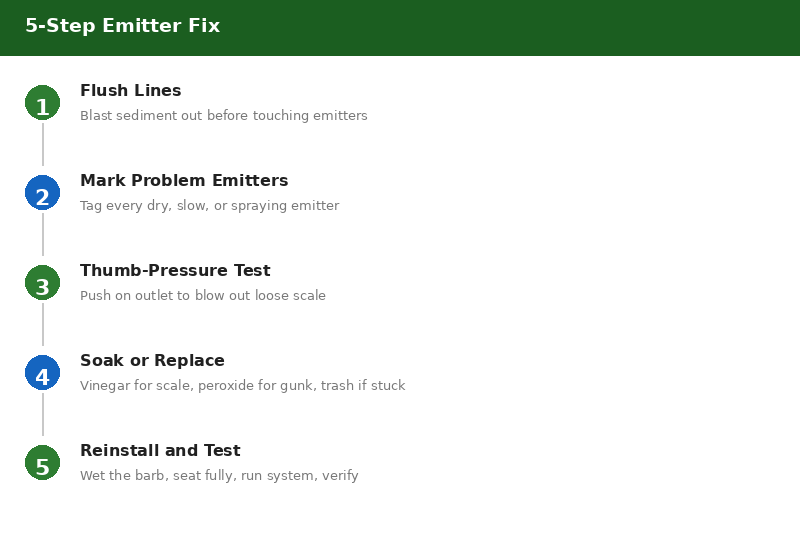
Step 1: Flush the lines first
Before you touch a single emitter, flush your mainlines and laterals. I see people skip this and then wonder why their emitters clog again two weeks later.
Turn off the system. Open the end caps on every lateral line. Turn the system back on and let it blast water through at full pressure for about two minutes per line. You want to see clear water coming out. If it’s brown or has visible particles floating in it, keep flushing until it runs clear.
If you have flush valves installed at the low points of your system (and you should), open those too. Sediment settles at low points.
While the system is flushing, check your filter. Unscrew it and look at the screen. If there’s a tear or the screen is bowed out from pressure, replace it. A torn 150-mesh filter is useless.
Step 2: Find and mark every bad emitter
Turn the system back to normal operating pressure (25 to 35 PSI for most residential drip — if you’re not running a pressure regulator, start there). Walk the entire system with a roll of colored flagging tape or a Sharpie marker.
Mark every emitter that is: completely dry, dripping noticeably slower than its neighbors (count drops for five seconds and compare), or spraying/shooting a stream instead of dripping.
Don’t guess. If you’re not sure whether an emitter is slow, compare it to one that’s clearly working. On a line with 20 emitters, the last one will always have slightly less flow than the first one — that’s normal friction loss. You’re looking for outliers.
Step 3: Try clearing without removing
For mineral scale buildup, sometimes you can clear the emitter while it’s still in the tubing. Turn the system on. Put your thumb over the emitter outlet and press firmly for about three seconds, then release. The pressure buildup behind your thumb can sometimes blow out loose scale.
This works about 40% of the time in my experience. If water flow returns to normal after two or three tries, you’re done with that emitter. If not, move to step 4.
For biological clogs, this almost never works. The gunk is too sticky.
Step 4: Pull and clean or replace
Turn off the system. Pull the bad emitter out of the tubing. If it’s a barbed emitter, grip it with pliers close to the tubing and rock it side to side while pulling. Don’t yank straight out — you’ll tear the hole.
Drop mineral-clogged emitters into a cup of white vinegar. Let them soak for at least 30 minutes, ideally an hour. Then rinse under running water and blow through the outlet side (or use a can of compressed air if that grosses you out). If you can see light through the emitter after soaking, it’s clear. Reinstall it.
For biological clogs, soak in 3% hydrogen peroxide instead of vinegar. Same timing — 30 to 60 minutes. Peroxide breaks down the organic slime. Vinegar does nothing to it.
Sediment-clogged emitters are trickier. If the particle is physically stuck inside the labyrinth, no chemical soak will help. Try forcing water backwards through the emitter with a syringe or your mouth (again, compressed air is more dignified). If that doesn’t work, toss it. Emitters cost about 30 cents each. Your time is worth more.
If more than a third of the emitters on a line are bad, just replace all of them. The remaining ones are probably on their way out too, and you’ll be back out there in a month doing this again.
Step 5: Reinstall and test
Wet the barb on the new or cleaned emitter before pushing it into the tubing hole. This helps it seat without tearing. Push it in until you feel the barb fully seat — you’ll usually feel a slight click or pop when the shoulder of the barb passes through the tubing wall.
For holes left by emitters you removed and aren’t replacing, insert a goof plug. Press it in firmly with your thumb. If water leaks around it later, pop a new plug in. Don’t try to reuse goof plugs. They’re a penny each.
Turn the system on and walk the line one more time. Check every emitter you touched. If one is still dry, pull it and check whether the hole in the tubing is blocked (yes, the hole itself can clog — poke it with the punch tool to clear it).
Keep it from happening again
Flush your lines twice a season. Once at startup in spring, once mid-summer. If you’re on well water with high iron, flush monthly.
Install a pressure regulator at the start of each zone. I use the 25 PSI Senninger or Rain Bird models — they’re about $12 each and last three to five years. Low pressure means lower flow velocity, which means more sediment drops out of suspension and into your emitters. Don’t skip this if your household pressure is above 40 PSI.
Check your filter every time you flush. Clean the screen or replace it if it’s damaged. A 150-mesh disc filter catches more than a screen filter and clogs less often, but costs about twice as much. Worth it for well water.
If you have persistent biological problems, add a 1-inch chlorine tablet to your filter housing once a month during the growing season. Not bleach — the tablets dissolve slowly and won’t damage your plants at the concentration that comes through the emitters.
And if you’ve got a line with emitters that clog every few weeks no matter what you do, it’s time to replace the whole lateral. Sometimes the inside of the poly tubing itself develops a biofilm that acts like a gunk factory. New 1/2-inch poly tubing costs about 15 cents a foot. For a 50-foot run, you’re looking at $7.50 and an hour of work. Do it.