Whatsapp:+86 17852301313 Email:tinghe.lv@yimaotomg999.com


The Underground Revolution: Subsurface Drip Irrigation and the Real Math Behind Water Savings

Here’s a number that should make you uncomfortable: in Kansas, 85% of all water diverted from ground and surface supplies goes to irrigation. That water sits on just 14% of the state’s cropland. In return, those irrigated acres crank out a third of the state’s entire crop production. The squeeze is obvious — massive water dependency, shrinking aquifers, and no backup plan.
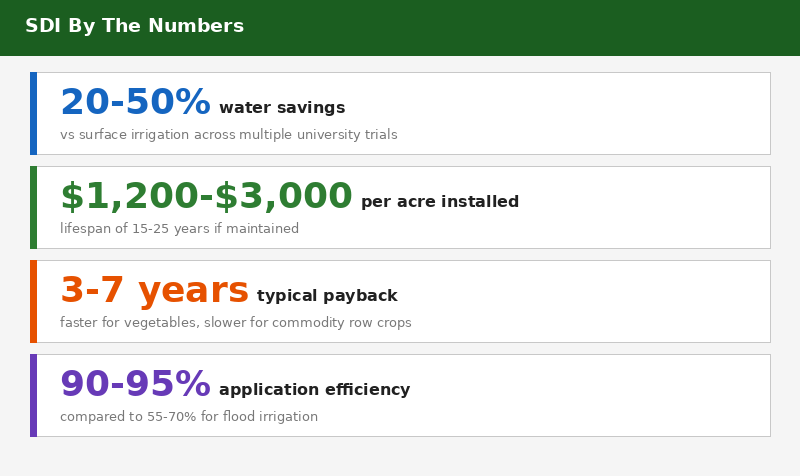
That tension is why subsurface drip irrigation (SDI) has gone from a niche experiment to something that Extension agents in the High Plains won’t shut up about. The pitch is seductive: bury drip tape 12 to 18 inches underground, deliver water directly to the root zone, and watch your evaporation losses crater while your yields stay steady or climb. The catch — and there’s always a catch — is that installing SDI costs somewhere between $1,200 and $3,000 an acre before you’ve grown a single thing.
So the question isn’t really “does it work.” It’s “does the math work for your operation.” Let’s walk through what the actual data says.
What subsurface drip actually saves (and what it doesn’t)
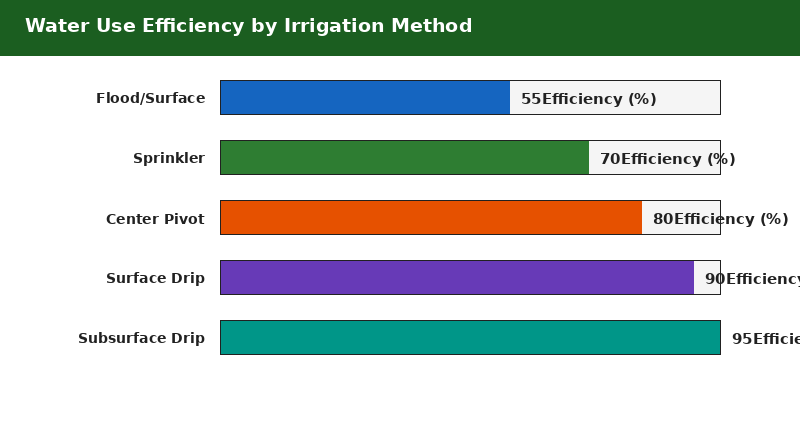
Surface irrigation — flood, furrow, you name it — operates at roughly 50-70% efficiency depending on soil type and how carefully it’s managed. Center pivots do better, around 75-85%. Surface drip pushes into the 85-92% range. SDI, with tape buried below the surface where evaporation can’t touch it, consistently hits 90-95% in university trials.
Those efficiency numbers translate into real gallons. A 2018 meta-analysis out of Texas A&M AgriLife, looking at cotton and corn across the Southern High Plains, found SDI reduced total water use by 25-45% compared to center pivot on the same fields. Not a typo. The biggest gains came during drought years when every inch of water mattered — exactly the conditions where you’d rather not be gambling.
But here’s something the brochures don’t advertise: water savings depend almost entirely on how you manage the system. If you ran your center pivot inefficiently before — overwatering, ignoring soil moisture data, praying for rain — then SDI will look like a miracle. If you were already dialed in on evapotranspiration scheduling and VRI nozzles, the gap narrows fast. Some K-State Extension trials showed SDI saving only 10-15% over a well-managed pivot. Still real, but not the kind of number that pays off a six-figure installation in three years.
The ROI math, crop by crop
SDI payback periods are wildly crop-dependent. Processing tomatoes in California’s Central Valley consistently hit break-even in 2-4 years, according to UC Davis field trials. The yield bump — 20-30% over furrow irrigation in some studies — combined with reduced disease pressure from dry foliage makes the math almost boringly favorable.
Alfalfa is trickier. A University of California study found SDI increased alfalfa yields by about 15% while cutting water use by 22%. But alfalfa is a low-margin commodity crop. At $200-250 per ton, that yield bump generates maybe $75-100/acre in extra revenue annually. Against a $2,000/acre install, you’re looking at a decade-plus payback. Most alfalfa growers I’ve talked to say they’d rather spend that capital on something with faster returns.
Corn and soybeans in the Midwest fall somewhere in the middle. K-State research on SDI corn showed yield increases of 10-20% in dry years, with water savings around 30%. Break-even typically lands in the 5-8 year range. The problem: commodity prices swing so much that a couple of bad market years can blow up the spreadsheet entirely. One western Kansas farmer put it to me this way: “I love the technology. I hate the financing.”
When drip is the wrong answer
Look, I write for a drip irrigation publication, so you’d expect me to evangelize. But SDI has real failure modes that don’t get enough airtime.
Rodents. Gophers and field mice love buried drip tape. They chew through it. Finding and repairing a leak 14 inches underground, in the middle of a 160-acre field, during growing season is about as fun as it sounds. Some growers in California’s almond country have spent more on rodent control and repairs than they saved on water in the first three years.
Root intrusion is the other silent killer. Fine roots from aggressive crops will find their way into emitter holes, especially if the system isn’t running regularly. Once roots colonize the inside of the tape, you’re not cleaning that out. You’re replacing it. Acid injection and herbicide-impregnated tape help, but they add operational complexity that a pivot simply doesn’t have.
And let’s be honest about germination. If you’re planting small-seeded crops — lettuce, carrots, onions — you need surface moisture to get them out of the ground. SDI buried at 14 inches does nothing for a seed sitting in the top inch of dry soil. Most growers solve this with temporary overhead sprinklers for germination, which means you’re running two systems until the crop establishes. That’s not a dealbreaker, but it’s a cost the ROI calculator probably missed.
Where SDI is absolutely winning
The Texas High Plains is ground zero for SDI adoption in the United States, and it’s not because farmers there are early adopters. The Ogallala Aquifer is declining faster than it recharges — some areas have lost over 150 feet of saturated thickness since the 1950s. Well capacities are dropping. Pumping costs are rising. In that environment, a system that cuts water use by 30% isn’t a luxury. It’s survival.
Texas A&M has documented hundreds of SDI installations across the Panhandle and South Plains, mostly in cotton and corn. The pattern is consistent: yields hold steady or increase slightly while irrigation demand drops by roughly a third. More important, nitrogen use efficiency goes up because you’re spoon-feeding nutrients through the drip system instead of broadcasting them and hoping rain doesn’t wash half of it past the root zone.
California’s permanent crop sector — almonds, wine grapes, citrus — has also embraced SDI, though for different reasons. Here the driver isn’t water scarcity alone; it’s labor. Drip systems can be automated. Fertigation replaces tractor passes. In an industry where labor costs have climbed 40% in a decade, removing trips across the field adds up.
The tech layer that actually matters
SDI by itself saves water. SDI paired with soil moisture sensors and automated scheduling saves dramatically more. The combination is where things get interesting.
A 2022 trial by the University of Nebraska-Lincoln compared standard SDI scheduling (fixed intervals based on historical ET) against sensor-driven SDI that adjusted timing based on real-time soil moisture at three depths. The sensor-driven approach used 18% less water with no yield penalty. Same crop, same field, same drip system — the only variable was whether a human was guessing or a sensor was measuring.
The sensors themselves aren’t expensive anymore. You can put volumetric water content sensors at 6, 12, and 18 inches for under $500 per monitoring station. A few stations across a pivot or drip block, connected to a cheap telemetry gateway, and suddenly you’re irrigating based on what the soil actually needs instead of what the calendar says. The payback on that sensor investment is usually measured in months, not years.
None of this requires a PhD in agronomy or a six-figure IoT platform. It requires a willingness to stop irrigating on autopilot.
What to ask before you dig
If you’re kicking around the idea of SDI, here are the questions that actually matter:
What’s your water cost — not just today, but in five years? If your aquifer is declining and energy prices are climbing, your baseline is a moving target. SDI looks better against a worsening alternative.
What crop are you growing and what’s the margin per acre-inch of water? High-value vegetables and permanent crops justify the investment quickly. Commodity row crops take longer and expose you to price risk.
Do you have the management bandwidth? SDI needs more attention than a center pivot — filtration, pressure regulation, flushing, chemigation. If you’re already stretched thin on labor, adding complexity is rarely the right move.
What’s your rodent situation? I’m only half joking. If you’ve got a gopher problem, fix it first or budget for repairs.
The technology works. The data is solid. The economics make sense under the right conditions. But — and this is the part that gets lost in the sales pitch — “the right conditions” are specific. If your water is cheap, your labor is tight, and your margins are razor-thin, SDI might be a financial mistake dressed up as a sustainability win. If your water is scarce, your crop is valuable, and you’re willing to actually manage the system rather than set it and forget it, there’s not much that beats it.