Whatsapp:+86 17852301313 Email:tinghe.lv@yimaotomg999.com


The Water You Can’t See: Why Burying Drip Lines Saves More Than You Think

The invisible problem with surface drip
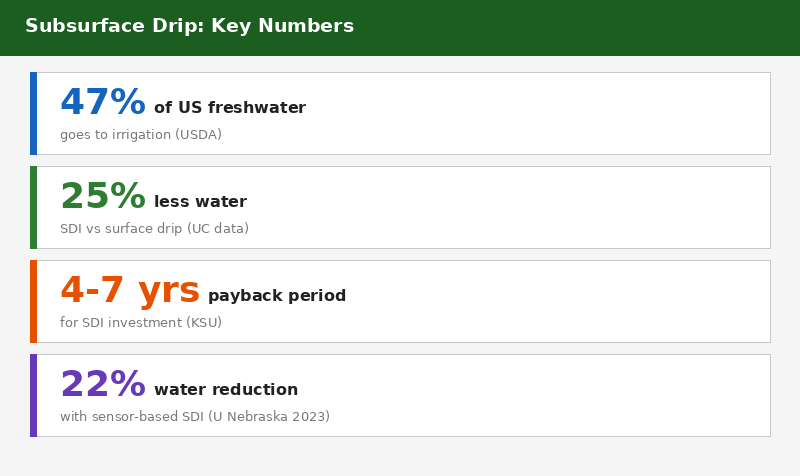
Here’s a number that keeps me up: American farms pulled 47 percent of the nation’s total freshwater withdrawals between 2010 and 2020, according to the USDA. That’s nearly half of all the fresh water anyone in the country used, across industry, cities, and households, going to irrigate 54.9 million acres of cropland.
And here’s the kicker: even the farmers who did the “right thing” and switched from flood irrigation to drip left a big chunk of water savings on the table. Not because they made a mistake. Because nobody told them about evaporation.
Surface drip tape does the job. You lay the lines on top of the soil, water drips out, roots drink. The problem is that on a hot day in the San Joaquin Valley or the Texas Panhandle, a meaningful percentage of that water never makes it to the roots. It evaporates off the soil surface before it can soak in. You paid for it, you pumped it, and then the sun took it.
What subsurface drip actually is
Subsurface drip irrigation (SDI) is exactly what it sounds like: you bury the drip lines 12 to 18 inches underground, directly in the root zone. The water comes out where the plants actually need it, with no path to the surface unless roots pull it up. No surface wetting means no evaporation. No runoff. No water pooling where weeds can use it.
This isn’t experimental technology. Kansas State University has been running SDI trials on corn since 1989, more than three decades of continuous data. Netafim, the Israeli company that invented modern drip irrigation in 1965, has been selling buried systems since the 1970s. The tech is proven. The question is why adoption is still so low.
What the numbers say
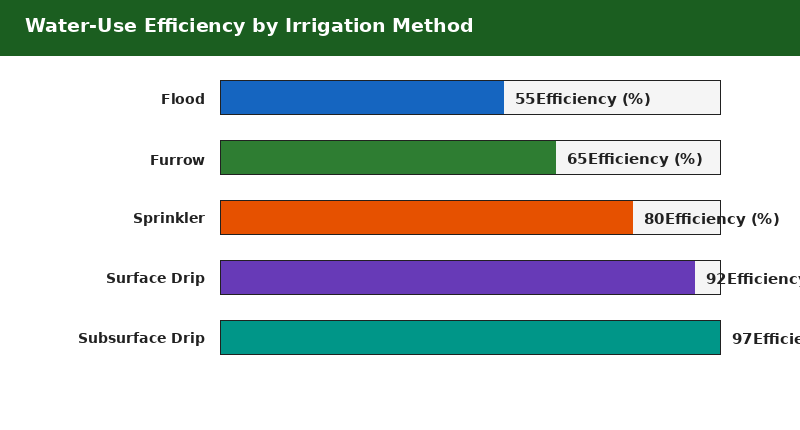
Surface drip irrigation runs at about 90 to 95 percent water-use efficiency. That sounds good until you compare it to flood irrigation at 50 to 70 percent. But SDI pushes efficiency to 95 to 98 percent. That extra 3 to 8 percentage points might sound incremental. On a 1,000-acre farm in a drought year, it’s the difference between finishing the season and fallowing half your fields.
The USDA’s own data shows that between 1979 and 2022, average irrigation application rates dropped from more than 2 acre-feet per acre to just over 1.5, a 25 percent improvement driven almost entirely by switching from gravity to pressurized systems. But that trend has basically plateaued. The last big efficiency jump is going to come from going underground.
Research from the University of California puts the evaporation savings from SDI at 10 to 25 percent compared to surface drip, depending on climate. In Arizona or the Central Valley in July, you’re at the high end of that range. In cooler, humid regions, the advantage shrinks.
Two places where this is actually working
Kansas corn. Kansas State’s long-term trials found that SDI on corn produced the same or better yields as center-pivot sprinklers while using 20 to 35 percent less water. Over a 15-year period, the buried drip lines held up with proper filtration and maintenance. The catch: the upfront cost was roughly $1,200 to $2,000 per acre, compared to $400 to $600 for a new center pivot on the same field. The payback period ran about 4 to 7 years depending on water costs.
California almonds. During the 2012-2016 drought, when surface water allocations went to zero in parts of the Central Valley, almond growers who had already converted to microirrigation survived. Those still on flood didn’t. The Almond Board of California reports that roughly 70 percent of almond acreage now uses some form of microirrigation. But here’s the thing: most of that is surface drip or micro-sprinklers. The growers who went a step further and buried their lines report an additional 15 to 20 percent reduction in water use, with no yield penalty. In some orchards, they actually got a slight yield bump because the dry surface reduced fungal pressure.
And then there’s Israel, which is basically the world’s working demo for this stuff. After Netafim commercialized drip irrigation in the 1960s, Israel went from water-scarce to water-secure in agriculture. Today, about 75 percent of Israel’s irrigated land uses drip, the country recycles 86 percent of its wastewater for agricultural reuse, and they export more agricultural technology per capita than anywhere else. None of that happens without buried pipes.
Here’s when SDI is a bad idea
I’m going to say something that drip irrigation companies hate: sometimes burying the lines is genuinely stupid.
If you’ve got rodents — gophers, ground squirrels, voles — they will find your buried drip tape and they will chew through it. Kansas State’s own trials noted rodent damage as the number one maintenance headache. You can buy deterrent tape with repellents baked in, and it helps, but it’s not foolproof.
If your soil is saline, SDI can concentrate salts at the wetting front, creating a salt band that eventually harms root growth. Surface drip lets salts flush downward with rainfall. Buried lines can trap them.
If you rotate crops annually — say, tomatoes one year, wheat the next — those buried lines are now in the wrong place for the new crop’s root architecture. You can’t just pick them up and move them. SDI makes the most sense in permanent or semi-permanent plantings: orchards, vineyards, alfalfa, continuous corn.
And if your water has high iron or calcium carbonate, the emitters will clog underground where you can’t see it happening. By the time the plants show stress, you’ve already got a problem that requires digging. Surface drip at least lets you spot-check emitters by walking the field.
What it costs and who should actually do it
SDI installation runs $1,500 to $3,000 per acre for a full system: drip lines, filtration, injection equipment, and the specialized plow or trencher to bury it. That’s 2 to 3 times the cost of surface drip. The payback comes from water savings (especially where water has a real price tag), reduced fertilizer costs (fertigation through SDI is precise and efficient), and in some cases, higher yields from drier canopy conditions.
If you pay nothing for water — if you’re pumping from a historic groundwater right with no metering — the math is hard to make work on water savings alone. But if you’re in a groundwater management district with allocations, or you’re paying $50 to $200 per acre-foot for surface water, SDI pencils out fast. The Kansas studies showed positive ROI within 4 years at water costs above $40 per acre-foot.
The other factor nobody talks about: labor. Once an SDI system is in, you’re not moving pipe, you’re not rolling up drip tape at the end of the season, you’re not dealing with surface lines getting snagged by equipment. One operator can manage hundreds of acres of SDI from a smartphone if the system has pressure sensors and flow meters installed.
Where this is headed: sensors in the dirt
The next evolution of SDI pairs buried drip lines with in-ground soil moisture sensors, connected to controllers that adjust irrigation schedules automatically. Companies like Jain Logic and Netafim’s NetBeat are already selling integrated systems where the soil tells the valves what to do, and the farmer gets an alert on their phone if something’s off.
Combine SDI with variable-rate irrigation, where different zones of a field get different amounts of water based on soil type and crop need, and you’ve got a system that can cut water use by 40 to 50 percent compared to flood, and 15 to 25 percent compared to surface drip, without reducing yield. A 2023 trial by the University of Nebraska on SDI corn with soil-moisture-based scheduling reported a 22 percent water reduction and a 4 percent yield increase compared to the producer’s standard surface-irrigated field next door.
That’s the real story here. Not that SDI is new. It isn’t. Not that it’s perfect. It absolutely isn’t. But the combination of buried lines, cheap sensors, and automated control is making efficiency gains that used to require a full-time irrigator walking fields. For the right farm, in the right conditions, burying the pipe is the best water investment you can make.