Whatsapp:+86 17852301313 Email:tinghe.lv@yimaotomg999.com


Drip Irrigation vs Sprinkler Systems: Which One Actually Saves You Money?

I get asked this question a lot. Homeowners want to know which system to install, and they want a straight answer. After installing both for over a decade, I’ve got one: it depends on what you’re watering. But for most people with gardens, flower beds, or shrubs, drip wins. Here’s the breakdown.
How Much Water Each System Actually Uses
Let’s talk numbers. A typical sprinkler system puts out anywhere from 1.5 to 4 gallons per minute per zone. Over a 30-minute cycle on an average quarter-acre lot, that adds up to roughly 200 to 400 gallons per session. Three times a week in July? You’re looking at 2,400 to 4,800 gallons a month just for the lawn.
Drip irrigation moves water at a fraction of that rate. Most drip emitters deliver 0.5, 1, or 2 gallons per hour. Not per minute, per hour. A 100-foot drip line with emitters spaced every 12 inches might run at 100 gallons per hour total. But here’s the thing: you run it less, because the water goes exactly where you need it. I typically set drip zones for 30 to 45 minutes, two or three times a week. The monthly total for a typical garden bed lands around 600 to 900 gallons.
The EPA says outdoor water use accounts for more than 30 percent of total household consumption, and in arid regions it can hit 60 percent. They also found that up to 50 percent of that outdoor water is lost to wind, evaporation, and runoff when you’re using inefficient methods. Sprinklers throw water into the air. On a breezy day, a chunk of it never touches the ground. Drip systems don’t have that problem.
The Efficiency Numbers Nobody Talks About
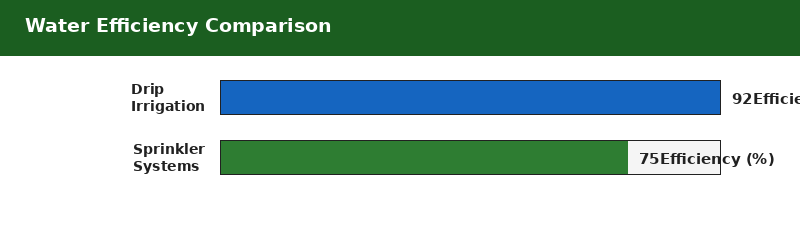
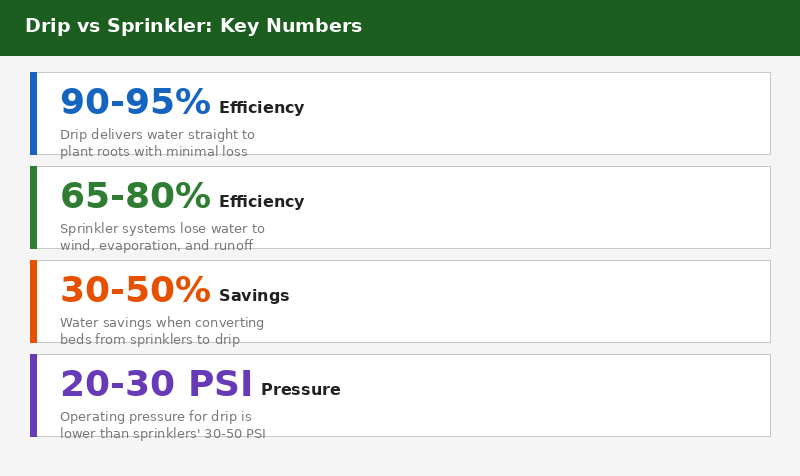
Drip irrigation runs at about 90 to 95 percent efficiency. That means 90 to 95 percent of the water coming out of the emitter actually reaches the plant roots. Sprinklers, depending on the type and weather conditions, clock in around 65 to 80 percent. Spray heads on a hot windy afternoon? You might be losing 40 percent of your water before it does anything useful.
I had a client in Phoenix who switched from pop-up sprays to drip for all his shrubs and flower beds. His July water bill dropped from $180 to $95. That’s not unusual. I’ve seen similar numbers in California, Texas, and Nevada. The savings come from two things: less water used per minute, and less water wasted to evaporation.
Pressure matters too. Sprinklers need 30 to 50 PSI to throw water far enough to cover the zone. Drip emitters are happy at 20 to 30 PSI, and most systems use a pressure regulator that brings it down to about 25 PSI. Lower pressure means fewer leaks, less strain on fittings, and longer system life.
What It Costs to Install (Real Numbers)
Let’s talk dollars. A DIY drip irrigation kit for a typical garden with four to six beds runs $60 to $200. That includes the tubing, emitters, fittings, a pressure regulator, and a filter. If you hire a pro to design and install a custom drip system for the same space, expect $400 to $900 depending on complexity and plant count.
A professionally installed sprinkler system for a standard suburban lawn sits in a different price bracket entirely. You’re looking at $1,800 to $3,500 for a typical quarter-acre lot. That includes the backflow preventer, controller, valves, pipe, and spray heads. DIYing a sprinkler system is harder than DIYing drip. You need to trench, calculate head spacing, match precipitation rates. It’s a weekend project that turns into a month-long headache for most people.
I tell people this: if you’re watering a lawn, you probably need sprinklers or rotor heads. Grass is the one thing drip doesn’t handle well unless you’re using subsurface drip, which is a whole different animal and costs more upfront. But if you’re watering trees, shrubs, flower beds, or a vegetable garden, there’s no good reason to use sprinklers for those zones.
Maintenance: What Goes Wrong and How Often
Sprinklers break. Spray heads get clogged with dirt or grass clippings. Pop-ups stick in the up position. Gear-driven rotors stop rotating. A single broken head on a 4 GPM zone can dump 240 gallons an hour into one spot until you notice the swamp in your lawn. Valves fail, usually the diaphragm, and that zone runs when it shouldn’t or doesn’t run at all.
Drip systems have their own issues, but they’re cheaper to fix. A clogged emitter is a $0.25 part and 30 seconds with a punch tool. A leak in 1/2-inch poly tubing gets fixed with a $2 coupler. The most common problem I see is people running drip without a filter. Municipal water has sediment, and even tiny particles will clog emitters over time. Always install a 150-mesh or 200-mesh filter right after the valve. It costs $15 and saves hours of troubleshooting.
Another thing: drip tubing degrades in direct sun. Black polyethylene tubing lasts 5 to 10 years exposed to UV, longer if you mulch over it. PVC pipe for sprinklers can go 20-plus years underground. So there’s a tradeoff on longevity. But when PVC breaks underground, you’re digging. When drip tubing cracks on the surface, you see the leak and fix it in five minutes.
Plants That Do Better on Drip
Here’s something that gets overlooked: plant health. Spraying water on leaves encourages fungal disease. Tomatoes, roses, squash, cucumbers. All of them get powdery mildew or leaf spot when water sits on the foliage overnight. Drip delivers water at the soil line. The leaves stay dry.
Deep watering is another benefit. Sprinklers tend to deliver water faster than soil can absorb it. You get runoff before you get deep saturation. Drip’s slow rate lets water percolate down 12 to 18 inches over the course of a 45-minute cycle. That encourages deeper root growth, which makes plants more drought-tolerant.
For trees, especially young ones with shallow root systems, drip is far superior. I’ve seen newly planted fruit trees on sprinklers struggle through summer while the same varieties on drip establish twice as fast. A 2 GPH emitter run for an hour delivers 2 gallons directly to the root ball. A sprinkler head 15 feet away might or might not reach it, and most of what does land there evaporates before it soaks in.
When Sprinklers Make Sense
I’m not saying sprinklers are obsolete. For cool-season turf like fescue or bluegrass, you need even coverage across a large area. Rotors and spray heads do that better than anything else. Athletic fields, common areas in HOAs, parks. Those are sprinkler territory.
Warm-season grasses like Bermuda and zoysia can get by with less water, but they still need sprinklers for coverage. The smart play is to put sprinklers on the lawn zones and drip on everything else. Run them on separate valves and separate schedules. Your controller should treat them as completely different systems because hydraulically, they are.
If you can only install one system and you’ve got a mix of lawn and landscaping, go with a hybrid approach. I install about half my jobs this way now. Lawn zones on rotor heads at 35 PSI, landscape zones on drip at 25 PSI, all running off the same controller but on different programs.
The Payback Timeline
Let’s run the numbers on a conversion. Say you’ve got a typical suburban lot: 3,000 square feet of lawn on sprinklers, and 800 square feet of beds that you’re also watering with sprinklers because that’s how the builder set it up. Converting those beds to drip costs about $300 in parts if you DIY, or $700 to $1,000 with a pro.
Your water savings on those beds will run 30 to 50 percent. On a $100 monthly summer water bill where landscaping accounts for maybe $50 of that and the beds are a third of the landscape, you’re saving roughly $5 to $8 a month during the growing season. Over a six-month watering season, that’s $30 to $48 a year. The payback on a DIY conversion is five or six years. The payback on a pro install is longer. But here’s what the payback math misses: your plants look better, you lose fewer of them, and you spend less time replacing dead shrubs. Those are real savings, they’re just harder to put on a spreadsheet.
That EPA stat about WaterSense controllers saving 15,000 gallons a year? That’s with a properly designed system. If your controller is smart and your emitters are efficient, the savings compound. I’ve seen households cut outdoor water use by 40 percent just by switching beds to drip and upgrading to a weather-based controller at the same time.
Bottom Line
If you’re watering flower beds, shrubs, trees, or a vegetable garden, go with drip. The efficiency numbers are better, the plant health is better, and the install is cheaper. If you’re watering a lawn, you need sprinklers. But don’t let your sprinklers water your beds too. That’s the mistake I see most often, and it’s the easiest one to fix.
Start with the beds. Convert them to drip this season. Next season, put a smart controller on the whole system. The season after that, audit your sprinkler heads and replace any that are misting or overspraying. Each step saves water and money, and you don’t have to do it all at once.