Whatsapp:+86 17852301313 Email:tinghe.lv@yimaotomg999.com


The Underground Bet That’s Quietly Changing How We Irrigate

The quiet underground bet that’s reshuffling how we irrigate
In 2018, a Kansas corn farmer named Dwane Roth did something that made his neighbors scratch their heads. He buried drip tape 14 inches under his cornfield and walked away from his center pivots. Three years later, Roth was using 55% less water per bushel than the county average, and his yields during the brutal 2022 drought actually went up while everyone else’s cratered.
Roth wasn’t being eccentric. Subsurface drip has been around since the 1960s in Israel, but the economics quietly flipped in the last decade. What’s happening in the Great Plains, California’s Central Valley, and increasingly everywhere else is a slow, undramatic shift that hardly anyone outside ag circles has noticed.
Above-ground irrigation fights physics, and physics usually wins. Sprinklers throw water through 100-degree air. Flood irrigation soaks the top few inches and hopes gravity sorts out the rest. On a hot July afternoon in western Kansas, you can lose 30 to 40 percent of what you pump before a corn root ever touches it. SDI skips the whole evaporation circus. It puts water directly in the root zone, underground, where the plant actually lives.
What subsurface drip actually is (and why you probably haven’t seen it)
SDI is drip irrigation buried 6 to 18 inches below the surface. The drip tape or tubing stays there permanently—or at least for 10 to 20 years, depending on the system. Water seeps out of emitters directly into the root zone. No surface wetting, almost no evaporation, no runoff. The soil surface stays dry, which sounds wrong if you grew up thinking plants need wet dirt. But roots don’t care about surface moisture. They care about what’s down where they live.
The buried part is why you don’t see SDI from the road. A pivot spinning in a circle is visible for miles. SDI fields look like absolutely nothing is happening. I suspect that invisibility is part of why adoption has lagged behind the technology’s performance. Farmers are visual creatures. If you can’t see the water going on, it’s harder to trust it’s working.
The numbers that should make flood irrigators nervous
The K-State research farm in Colby, Kansas, has been running SDI trials on corn since 2015. Here’s what the data says:
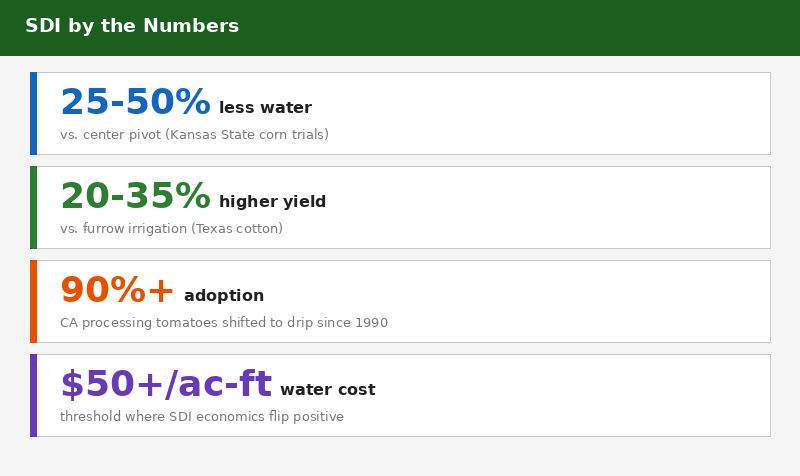
- Water savings: SDI used 25 to 50 percent less water than center pivots while maintaining or increasing yields. In drought years, the gap widened even more.
- Yield bump: 5 to 15 percent higher corn yields in dry years. In wet years, yields were comparable, but with a lot less water applied.
- Nitrogen efficiency: You can spoon-feed fertilizer through the drip system (fertigation), so nitrogen use efficiency jumped 20 to 30 percent. Less fertilizer running into groundwater, more ending up in the plant.
Down in Texas, the numbers get sharper. Texas A&M AgriLife has documented SDI cotton operations in the High Plains using 40 to 60 percent less water than furrow irrigation while producing 20 to 35 percent higher lint yields. Cotton’s a deep-rooted crop that responds to consistent moisture at depth. Flood it once a week and the plant cycles through feast and famine. Drip it daily at the root zone and it just keeps growing.
California’s processing tomato industry is the case study I keep coming back to. In 1990, roughly 5 percent of California’s processing tomatoes were under drip. By 2018, it was north of 90 percent. Over the same period, water use per ton of tomatoes dropped more than 30 percent. The shift wasn’t driven by environmental guilt. It was driven by processors demanding consistent quality and farmers realizing drip penciled out. When an entire crop sector moves 85 percentage points in 28 years, the economics stop being theoretical.
The contrarian take: when drip isn’t the answer
I should be honest here, because too many irrigation articles read like equipment brochures. SDI has real downsides and it’s flat-out wrong for some situations.
Upfront cost is brutal. Installing SDI runs $1,200 to $2,500 per acre depending on spacing, depth, and filtration requirements. A center pivot might cost $400-800 per acre. If you’re farming commodity corn on thin margins, that difference matters. The payback period can stretch to 5-7 years, and most banks don’t love lending against buried plastic pipe.
Rodents are not your friends. Gophers, ground squirrels, and mice apparently find buried drip tape irresistible. A single gopher can chew through enough emitters to create dry spots across half an acre before you notice. Repair means digging. Digging means time and money. Some farmers in rodent-heavy areas have abandoned SDI entirely after a few seasons of playing whack-a-mole with irrigation repairs.
You’re married to it. Once SDI is in the ground, you can’t till conventionally. No deep ripping, no moldboard plowing. The tape is down there, and hitting it with a shank turns a $2,000/acre investment into a very expensive recycling project. This forces a shift to no-till or minimum-till practices, which is great for soil health but requires different equipment, different herbicides, and a different mindset.
Bad water kills systems. If your water source has high iron, calcium carbonate, or biological slime, you need serious filtration and possibly chemical treatment. Neglect the filtration and emitters clog. Clogged emitters underground don’t announce themselves. You find out when plants start yellowing in streaks across the field. By then, yield loss is already baked in.
When the math actually works
SDI isn’t for everyone. Here are the conditions where it actually pencils out:
High-value crops first. Vegetables, orchards, vineyards, and specialty crops with gross returns above $3,000 per acre can justify SDI almost anywhere. The water savings are gravy. The real value is in uniformity and quality. Processing tomato contracts often include quality premiums that SDI helps hit consistently.
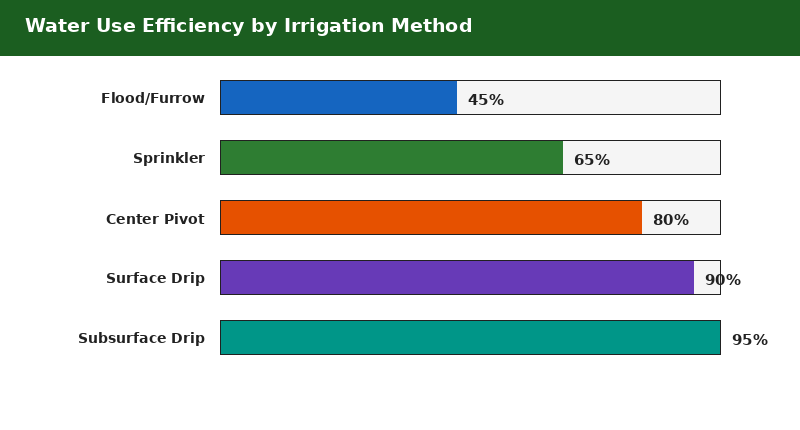
Water costs above $50 an acre-foot. When water gets expensive—from pumping costs, scarcity pricing, or regulatory limits—the efficiency gap between SDI and everything else starts dominating the math. In parts of the Ogallala Aquifer region, well depths have doubled in 30 years and pumping costs have followed. At $100 an acre-foot, a 95 percent efficient system vs. an 80 percent pivot saves real money, every season.
Regulatory pressure. California’s Sustainable Groundwater Management Act (SGMA) is forcing groundwater basins to balance withdrawals with recharge. Farmers in critically overdrafted basins don’t have the option of “business as usual.” SDI becomes one of the few tools that lets you keep farming while cutting water use by a third or more. It’s not voluntary efficiency. It’s “figure it out or lose the right to pump.”
Where labor is scarce. This one surprised me. SDI systems, once installed, need surprisingly little labor during the growing season. No moving hand-lines, no adjusting gun sprinklers, no walking furrows to check for breaches. One operator can manage hundreds of acres from a smartphone. In regions where farm labor keeps getting harder to find and more expensive, that’s a real advantage.
What the next decade looks like
Three things are converging in a way that’s going to push SDI adoption a lot higher than it is now.
1. Cheaper sensors, better automation. Soil moisture sensors that cost $800 five years ago now go for under $200. Paired with SDI, they let you irrigate based on what the soil actually needs, not a calendar date. Add a cellular-connected controller and you manage irrigation from anywhere with cell service. This shifts SDI from “efficient hardware” to something closer to a precision system.
2. Groundwater running out. The Ogallala Aquifer underlies 174,000 square miles across eight states and supports roughly 30 percent of US crop production. Parts of it have dropped 150 feet since 1950. In the Texas Panhandle, some wells went dry years ago. The places losing groundwater fastest map almost perfectly onto the places where SDI saves the most water. As well levels keep dropping, adoption curves should steepen.
3. Carbon and water markets, slowly becoming real. Emerging ecosystem service markets are starting to pay farmers for water conservation and soil carbon sequestration. SDI and no-till farming go together, which means they stack with carbon credit programs. Less pumping means lower diesel or electricity use—another potential revenue stream. None of these markets are mature enough to bank on yet, but they’re creeping from pilot project to actual revenue faster than I expected.
The bottom line, without the brochure
I don’t think SDI is a magic bullet. It’s expensive to install, it locks you into a management system, and it fails in ways that are harder to diagnose than a broken sprinkler head. But the gap between what it can do and what most farmers are currently doing is getting hard to ignore.
Dwane Roth’s neighbors eventually stopped scratching their heads. Two of them installed their own SDI systems in 2023. Not because anyone convinced them with a PowerPoint. Because when the drought hit and Roth’s corn was still standing while theirs was firing leaves, the data wasn’t abstract anymore. It was visible from the county road.
Water isn’t getting more abundant. Electricity for pumping isn’t getting cheaper. The people who figure out how to grow more with less are building farms that will still be operating in 2050, when half their neighbors’ wells have gone dry. That’s not a prediction. It’s just math.
Sources: Kansas State University Northwest Research-Extension Center SDI trials (2015-2023); Texas A&M AgriLife Research, “Subsurface Drip Irrigation in the Texas High Plains” (2020); USDA NASS 2017 Census of Agriculture, Irrigation and Water Management Survey; UC Davis Agricultural Issues Center, “Drip Irrigation in California Processing Tomatoes” (2019); FAO AQUASTAT Database; USGS Ogallala Aquifer monitoring data.