Whatsapp:+86 17852301313 Email:tinghe.lv@yimaotomg999.com


Drip Irrigation vs Sprinklers: Which One Actually Saves You More Water?

Drip Irrigation vs Sprinklers: Which One Actually Saves You More Water?
I’ve installed both. Hundreds of systems at this point. And I still get the same question from every other homeowner who calls: “Should I go with drip or sprinklers?”
There’s no one-word answer, but there are numbers that make the decision a lot easier than most people think. Let me walk you through what I’ve learned in the field.
How They Actually Work
Sprinklers spray water into the air. Some of it lands on your plants. The rest evaporates, drifts off in the wind, or pools on the sidewalk. Standard pop-up spray heads throw water at about 1.5 inches per hour across a fan-shaped pattern. Rotor heads move slower but cover more ground.
Drip irrigation doesn’t spray anything. Water moves through polyethylene tubing at low pressure and exits through emitters, drip tape, or micro-sprayers directly at the soil surface. Typical emitter flow rates run 0.5, 1.0, or 2.0 gallons per hour. That’s a slow trickle measured in hours, not minutes.
The pressure difference matters too. Sprinklers want 30 to 50 PSI to work right. Drip systems run happily at 15 to 30 PSI, which is why almost every drip setup has a pressure regulator inline right after the backflow preventer.
Water Efficiency: The Numbers Don’t Lie
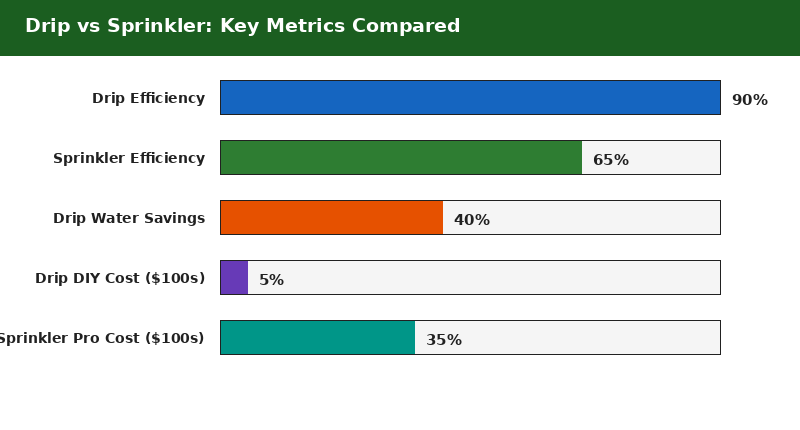
Here’s the stat that usually decides things: drip irrigation is about 90% efficient. Sometimes higher. The EPA’s WaterSense program has been tracking this for years. Sprinklers, depending on wind and heat and how well they’re maintained, land somewhere between 50% and 75%.
I’ve seen older sprinkler systems where half the water never reaches a plant. Overspray onto driveways. Misted output on a windy afternoon. Heads that have drifted out of alignment over a few seasons. It adds up fast.
Colorado State University Extension puts the water savings from switching to drip at 30% to 50%. That tracks with what I see on water bills after a conversion, especially in places with hot, dry summers like the Southwest and inland California.
A drip system puts water within inches of the root zone. No mist. No wind drift. No runoff. What comes out of the emitter soaks into the soil right where you want it. That’s the whole reason the efficiency numbers are so lopsided.
Where Each System Actually Wins
Drip wins on:
- Vegetable gardens and raised beds. Row crops love drip tape buried under mulch.
- Shrub borders and foundation plantings. You can run 1/2-inch tubing behind the bushes and nobody sees it.
- Slopes. Sprinklers on a hillside mean runoff. Drip on a hillside means water goes straight down into the soil with an emitter spacing of about 18 inches.
- Anywhere water is expensive or restricted. If your utility has tiered pricing, the efficiency difference shows up directly on your bill.
Sprinklers win on:
- Large lawn areas. Nobody is going to drip-irrigate a half-acre of turfgrass. It doesn’t make sense.
- Ground cover and densely planted beds where individual emitters would be a nightmare to lay out.
- Establishing new seed. You need even surface moisture for germination, and drip just can’t do that at scale.
- Systems where you never want to think about maintenance again after install (more on that below).
What Does It Cost?
A DIY drip system for a typical residential garden runs somewhere between $300 and $800 in materials. Tubing, emitters, a filter, a pressure regulator, a backflow preventer, some fittings. If you hire it out, expect $1,200 to $2,500 depending on the number of zones and how complicated the layout is.
Sprinkler systems cost more up front. A professionally installed system for a standard suburban lot runs $2,500 to $5,000. The trenching and the PVC work add up. Plus you need a backflow preventer that meets local code, which alone can run $200 to $500.
But the real cost difference shows up over time. I’ve had clients in Phoenix cut their summer water bill by 40% after converting flower beds from spray heads to drip. At that rate, the drip retrofit pays for itself in two seasons.
The Maintenance Catch
Sprinklers are fairly forgiving. A head breaks, you swap it. The pattern drifts, you adjust it with a screwdriver. You walk around once a month, turn each zone on, and fix anything that looks off. Maybe 15 minutes.
Drip takes more attention. Emitters clog, especially if your water has high mineral content or you skip the filter. A 150-mesh filter catches particles down to about 100 microns, which handles most municipal water, but you still need to clean it every 2 or 3 months. Rodents occasionally chew through the tubing. And because everything is at ground level under mulch, you won’t spot a problem until a plant starts looking stressed.
I tell every customer the same thing: if you’re the type who notices when a plant looks off and you’ll spend 10 minutes flushing a line, drip is fine. If you want to set a timer and forget the system exists for six months, stick with sprinklers.
Can You Mix Both?
Yes, and most of the better installs I’ve done use both. Sprinklers on the lawn zones. Drip on the flower beds, vegetable garden, and shrub lines. They run off the same controller. You just need separate valves because the run times are so different: sprinkler zones might run 15 to 20 minutes. Drip zones frequently run 45 minutes to an hour at those low GPH rates to put down the same volume of water.
A good smart controller handles this without much fuss. You program each zone’s type, plant material, soil type, and sun exposure, and it adjusts run times automatically based on local weather data. Rachio and Hydrawise are the two I install most often, and both handle mixed drip-and-spray setups cleanly.
So Which One Should You Pick?
If you’re irrigating a lawn or a large open area, go with sprinklers. There’s no practical alternative.
If you’re irrigating garden beds, shrubs, trees, or anything on a slope, go with drip. The water savings are real and the plants will be healthier. You’ll trade some extra maintenance for lower bills and fewer disease issues, since the foliage stays dry.
And if you have both situations on the same property, which most people do, run a mixed system. It costs a bit more to set up two zone types, but you’ll make it back on the first full irrigation season.
One last thing: if you’re in a drought-prone area with watering restrictions, check your local ordinance. Some municipalities in California and Colorado now require drip or subsurface irrigation for anything that isn’t turfgrass. It’s not always about preference. Sometimes the decision’s already been made for you.