Whatsapp:+86 17852301313 Email:tinghe.lv@yimaotomg999.com


Buried Money: What Subsurface Drip Irrigation Actually Costs and Saves

Buried Money: What Subsurface Drip Irrigation Actually Costs and Saves
A corn farmer in western Kansas pulling from the Ogallala Aquifer puts about 48 inches of water on his field every season. The crop uses maybe 22 of them. The rest evaporates, runs off, or sinks past the root zone. At 12 cents per kilowatt-hour for pumping, that’s roughly $60 per acre he’s spending just to heat the atmosphere.
Multiply that by a few hundred acres and you’re looking at real money vanishing into thin air. This isn’t a conservation problem dressed up in environmental language. It’s a straight business problem. And subsurface drip irrigation (SDI) promises to solve it, delivering water directly to the root zone at 90 to 95% application efficiency compared to 40 to 60% for flood and furrow.
But SDI isn’t cheap, and it isn’t for everyone. A buried drip system costs $1,200 to $3,500 per acre to install. Tape gets chewed by gophers. Emitters clog if your water quality is poor. And sometimes the water you “save” just gets used to bring more acres into production, leaving the aquifer no better off than before.
So what do the numbers actually say? I dug through extension bulletins, USDA survey data, and real farm case studies to figure out when SDI pays off and when you should keep your checkbook closed.
What Subsurface Drip Actually Costs (and What You Get Back)
Installation runs $1,200 to $3,500 per acre depending on crop spacing, soil type, and whether you DIY or hire it out. That’s real money. But the cost has dropped about 30% over the last decade as more contractors enter the market and tape manufacturing improves.
Kansas State researchers tracked SDI systems in the Ogallala Aquifer region and found something interesting: the systems that paid for themselves fastest weren’t on the highest-value crops. They were on corn and soybeans where the water savings translated directly into acres you could keep farming as wells declined. A 2019 K-State extension bulletin documented a grower near Garden City who installed SDI on 320 acres of corn. His pumping costs dropped $28 per acre in year one. By year four, the system had paid for itself through lower energy bills alone, before accounting for the 18-bushel yield bump.
For high-value crops the math tilts harder. Processing tomato growers in California’s Central Valley using SDI reported 20 to 30% yield increases with 25% less water compared to furrow irrigation. UC Davis trials published in 2018 backed this up. At $80 per ton for processing tomatoes, that’s an extra $1,200 to $1,800 per acre. The tape paid for itself in a single season.
Cotton in the Texas High Plains tells a similar story. Texas A&M AgriLife Extension documented a 22% yield increase on SDI cotton plots near Lubbock between 2016 and 2020, using 28% less water than center pivot. Cotton at 70 cents a pound doesn’t leave much margin for error. The water savings kept those acres in production during drought years when pivot-irrigated fields got cut back.
The Efficiency Numbers That Actually Matter
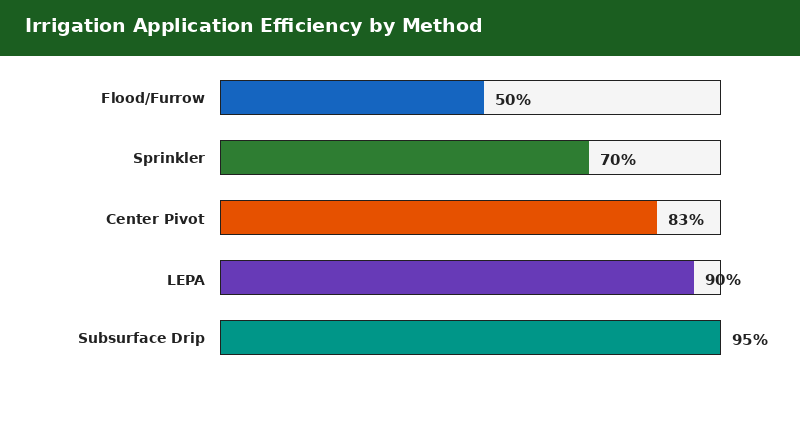
Every irrigation brochure throws around “90% efficiency” like it means something. In practice, application efficiency varies wildly by method, by weather, and by operator attention. Here’s what the USDA NRCS and university data actually show:
Flood and furrow irrigation land somewhere between 40 and 60% efficiency on most soils. A lot of the water goes past the root zone or evaporates before it does anything useful. Center pivots with low-pressure drop nozzles can hit 80 to 85% under good management. Subsurface drip consistently measures at 90 to 95%, and the reason is boring but important: the water goes straight to the root zone with almost no evaporation and no runoff.
What that means on the ground: if your corn needs 24 inches of water per season, a flood system might need to apply 48 inches. A pivot might need 28 to 30 inches. SDI can get it done with 25 to 26 inches. When you’re pulling from a declining aquifer or paying 12 cents per kilowatt-hour to pump, those inches add up fast.
The catch most efficiency discussions skip is that SDI doesn’t eliminate deep percolation. Put the tape too deep in sandy soil and you’ll still lose water below the root zone. A soil moisture sensor network paired with the system matters as much as the system itself.
Where Drip Isn’t the Answer
Nobody selling drip tape wants to talk about this, but here it is: SDI is a terrible choice for some situations.
If your water has high iron or calcium carbonate content, emitters clog. Reverse flushing and acid injection help, but they add labor and chemical costs that erode the savings. One western Kansas grower I read about through extension reports spent three seasons fighting iron bacteria in his tape before abandoning the system entirely. That’s a $300,000 mistake.
Rodents are another problem nobody warns you about until you’ve already paid for the tape. Gophers and field mice chew through buried drip lines. Texas A&M documented rodent damage in 15 to 20% of surveyed SDI installations in the southern High Plains. Repairs require digging up sections of field and splicing tape, which is miserable work in July.
For small diversified vegetable operations with short crop rotations, the cost of moving and reinstalling tape every season can kill the economics. A well-designed low-pressure overhead system might get you 80% efficiency for 20% of the cost. If you’re growing 47 different crops on 3 acres, skip the buried tape and invest in good soil organic matter instead. Higher organic matter holds more water regardless of how you apply it.
And here’s maybe the most uncomfortable truth: sometimes the water you “save” with high-efficiency irrigation doesn’t actually get saved. It just gets used to bring more acres into production. The Jevons paradox applies here too: efficiency gains can increase total water consumption when the saved water gets applied to additional land instead of staying in the aquifer. Parts of the High Plains are living this right now.
What the USDA Numbers Tell Us
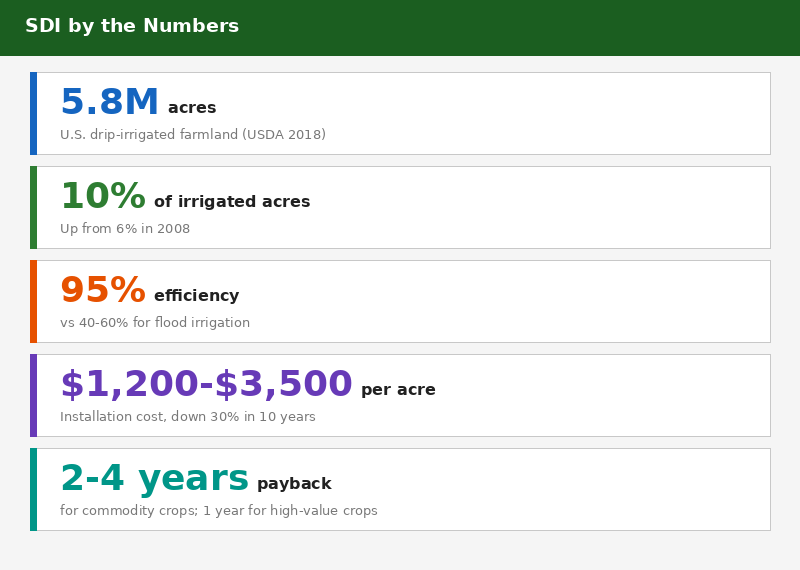
The USDA’s 2018 Irrigation and Water Management Survey found that about 58 million acres of U.S. farmland received irrigation. Drip, trickle, and micro-irrigation covered roughly 5.8 million of those acres, or about 10%. That’s up from 6% in 2008.
The growth isn’t evenly distributed. California leads with over 2 million drip-irrigated acres, driven by orchards, vineyards, and vegetables. Nebraska’s drip acreage tripled between 2008 and 2018, mostly on specialty crops. But the big surprise is the southern Plains: Texas, Oklahoma, and Kansas collectively added more than 500,000 drip acres during that decade, almost entirely on commodity row crops.
That last number matters because it means SDI isn’t just for almonds and vineyards anymore. When corn and cotton growers in water-stressed regions run the numbers and decide drip pencils out, the technology has crossed into mainstream territory.
The survey also confirmed something worrying: only 38% of irrigators reported using any soil moisture sensing or irrigation scheduling technology. That means 62% of irrigated acres are watered on feel, calendar, or habit. A $3,000-per-acre SDI system without moisture sensors is a sports car without a fuel gauge. You’re still guessing.
One Grower’s Experience: Cotton in the Texas Panhandle
The Texas Alliance for Water Conservation (TAWC) ran a multi-year demonstration project in the late 2010s comparing SDI, LEPA, and conventional center pivot on cotton. One participant, farming near Plainview, converted 240 acres to SDI in 2017 after his well output dropped from 600 to 400 gallons per minute over five years.
His pivot-irrigated acres averaged 2.5 bales per acre on 18 inches of applied water before the conversion. The SDI acres produced 3.1 bales on 12.5 inches of water in the first full season. That’s a 24% yield increase on 30% less water. By 2020, after dialing in the nutrient injection system and learning the moisture sensor placement, he was hitting 3.3 bales on 13 inches.
His energy bill dropped from $54 to $32 per acre. The system cost $2,100 per acre to install, including the filtration station and controller. Simple payback at commodity cotton prices took just under four years. When cotton prices spiked in 2021, payback had already happened.
I keep coming back to this case because it wasn’t a research plot. It was a commercial operation with normal equipment breakdowns, labor turnover, and weather surprises. The system worked but it wasn’t magic. First year, he over-irrigated because he didn’t trust the moisture sensors. Second year, gophers found a weak spot and he replaced 800 feet of tape. Real farming, real results.
The Labor Math Nobody Discusses
What nobody talks about with SDI is labor. Flood irrigation requires someone to move siphon tubes and check gates. Center pivots need gearbox maintenance and tire changes. SDI, once installed, mostly sits there.
A 2020 survey by the Irrigation Association found that growers with SDI reported spending 60 to 80% less time on irrigation labor compared to surface irrigation. For a 500-acre operation, that can mean freeing up a half-time employee for other work or eliminating a seasonal position entirely. At $15 an hour for ag labor, that’s real savings that don’t show up in the water efficiency numbers.
The downside nobody mentions: when something does go wrong with SDI, it’s harder to fix than a surface system. A leak in buried tape might not be visible for weeks. The labor shifts from daily operation to periodic monitoring and maintenance. Some growers hate the loss of visible feedback. You can’t look at a field and see water flowing through buried tape the way you can with furrow irrigation. It requires a different kind of attention.
Should You Do It? A Practical Checklist
Here’s what I’d tell a grower who’s on the fence:
SDI makes the most sense when at least three of these are true: your water costs are rising or your allocation is shrinking, you’re growing a crop worth more than $500 per acre in gross revenue, you intend to farm the same ground for at least five more years, and you’re willing to invest in moisture monitoring alongside the tape.
It probably doesn’t make sense if you’re on rented ground with a short-term lease, your water quality has high iron or carbonate levels, you’ve got heavy gopher pressure, or you’re farming small diversified plots where crop rotation changes annually.
The technology keeps improving. Pressure-compensating emitters have gotten cheaper and more reliable. Automated flushing systems reduce the maintenance burden. But the core question hasn’t changed: does the math work for your specific dirt, your specific water, and your specific crop?
Run the numbers on your own operation. Talk to growers in your area who’ve done it, not just the ones who’ll tell you it’s great. Get the full picture, gophers and all.