Whatsapp:+86 17852301313 Email:tinghe.lv@yimaotomg999.com


Subsurface Drip Irrigation: The Numbers Behind the Hype (and When It’s Actually Worth It)

Agriculture drinks 70% of the world’s freshwater while 1.8 billion people face absolute water scarcity. Subsurface drip irrigation promises to stretch every drop further — but the math isn’t as simple as the sales pitch.
How much water are we really burning through?
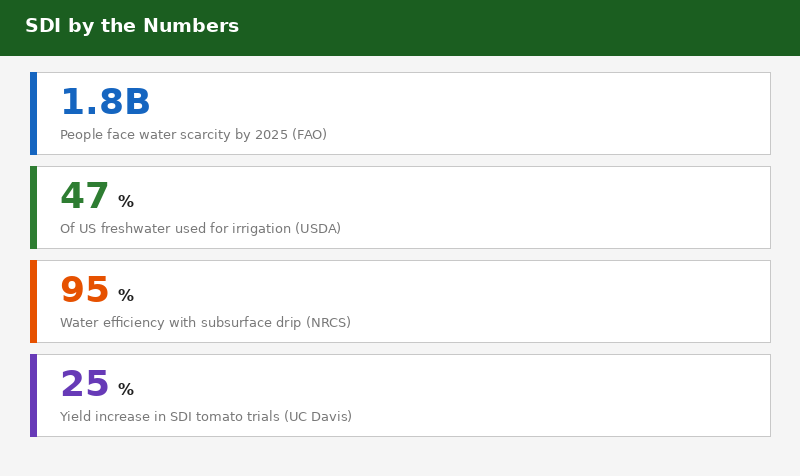
Here’s a number that stuck with me: agriculture drinks about 70% of the world’s freshwater. In the United States alone, the USDA puts irrigation at 47% of total freshwater withdrawals. Globally, the FAO estimates 1.8 billion people will be living under “absolute” water scarcity conditions by 2025. Not “maybe someday.” Now.
Meanwhile, the average American irrigation application rate has actually dropped from more than 2 acre-feet per acre in 1979 to just over 1 acre-foot today. Farmers are already tightening the tap. The question is whether they’re tightening it enough, and whether the tools they’re reaching for actually deliver.
Enter subsurface drip irrigation, or SDI. It’s not new. Netafim, the Israeli company that invented drip irrigation, has been at this since 1965. But SDI — running drip lines permanently buried 12 to 18 inches below the soil surface — is having a moment. And like most moments in agriculture, it’s a mess of tradeoffs.
What subsurface drip actually is (and why it’s different from the drip you know)
Standard drip irrigation puts tubes on top of the soil or just under mulch. Water drips out, soaks down, roots find it. SDI buries those tubes deeper, permanently, where they stay for years. No moving them between seasons. No tripping over lines. No surface evaporation at all.
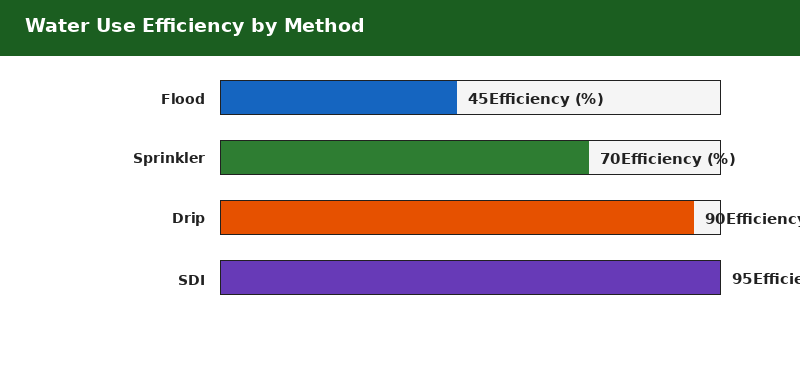
The efficiency numbers are stark. Standard drip hits around 90% water use efficiency. Sprinklers manage 65 to 75%. Flood irrigation, still the most common method globally, scrapes by at 40 to 50%. SDI pushes past 95% when it’s working right. The NRCS has been documenting these gaps for decades. The physics is simple: water goes directly to the root zone. Nothing evaporates off the surface. Nothing runs off into a ditch.
But efficiency isn’t the whole story. What’s interesting is what happens to the crop itself.
The California tomato experiment
In California’s Central Valley, where water costs have become existential, researchers at UC Davis spent years running SDI trials on processing tomatoes. The numbers: 15 to 25% yield increases while using 20 to 30% less water compared to traditional furrow irrigation. Same fields, same soil, same sun. Just different plumbing.
Why? Two reasons. First, SDI lets you spoon-feed water exactly when the plant needs it. Tomatoes are dramatic about water: too much during ripening and you get watery fruit, too little during fruit set and you get nothing at all. SDI gives you control that flood irrigation doesn’t. Second, because the surface stays dry, you get less weed pressure and fewer fungal diseases that thrive in humidity.
A tomato processor in the Valley told researchers they were seeing higher brix (sugar content) in SDI-grown fruit, which matters when you’re making paste. More sugar per tomato means less energy to process it. That detail doesn’t show up in yield-per-acre stats, but it shows up in the checkbook.
India tells a similar story at a different scale. Research from ICAR, India’s agricultural research body, found drip irrigation reduced water use by 40 to 65% across crops while yields jumped 20 to 40%. For smallholder farmers growing vegetables on an acre or two, that’s the difference between selling at market and watching plants wilt.
Here’s the part nobody wants to talk about
SDI is great. SDI is also expensive, finicky, and sometimes the wrong choice entirely. I say this as someone who wants more farmers to use it.
The upfront cost is brutal. Installing SDI runs anywhere from $1,500 to $3,000 per acre depending on row spacing, soil type, and filtration requirements. For a 100-acre vegetable operation, that’s $150,000 to $300,000 before a single seed goes in. In sub-Saharan Africa, where drip adoption sits below 5%, it’s not that farmers don’t want it. They can’t front the cash, and the financing infrastructure isn’t there.
Then there’s the maintenance reality. Buried lines clog. Roots can grow into emitters. Rodents chew through tubing. Diagnosing a clogged line you can’t see is a special kind of frustration. You need excellent filtration, regular flushing, and sometimes acid injection to keep things running. These are solvable problems, but they’re problems that don’t exist with a sprinkler.
And here’s the contrarian point that gets left out of most drip irrigation articles: for some crops, SDI just doesn’t pencil out. Wheat, corn, soy — commodity row crops grown on thousands of acres with thin margins — are unlikely to ever justify buried drip. The math doesn’t work. If you’re farming 2,000 acres of corn in Nebraska, a center pivot that lasts 25 years and costs a fraction per acre is the rational choice. Not everything needs to be drip.
The sweet spot for SDI is high-value crops on modest acreage where water is scarce or expensive: vegetables, orchards, vineyards, berries. Almonds in California. Wine grapes in Washington. Tomatoes in Israel. These are the places where the return on investment shows up fast enough to matter.
What the data says about the big picture
The USDA’s 2023 Irrigation and Water Management Survey found that about 74% of US irrigated cropland now uses pressurized irrigation systems. That’s up significantly from a generation ago. About 45% of irrigation water still comes from surface sources, with the rest drawn from groundwater. The shift toward pressurized systems — sprinklers and drip — is real and accelerating.
The global drip irrigation market backs this up. Valued around $8 billion in 2023, it’s projected to hit somewhere between $15 and $18 billion by 2030. That’s not hype-cycle growth. That’s farmers voting with their wallets because the water math is getting too tight to ignore.
But the global numbers hide a brutal geographic split. Places with strong agricultural extension services and government subsidies — Israel, California, Australia — have adoption rates above 50% for drip on appropriate crops. Places without those supports, like much of sub-Saharan Africa, parts of South Asia, and smallholder regions in Latin America, are stuck in single digits. The technology exists. The distribution of it is wildly unequal.
When IoT and SDI collide
This is where things get interesting. SDI is already efficient. Add soil moisture sensors, automated valves, and a control system that adjusts watering based on real-time data, and the efficiency numbers get almost absurd.
A trial in Australia’s Murray-Darling Basin combined SDI with IoT soil probes and cut water use by an additional 12% beyond what SDI alone achieved. The system was micro-dosing water: small pulses multiple times per day instead of one long irrigation event. The plants got exactly what they needed, when they needed it, and nothing more.
This is the direction everything is heading. Not because it’s cool technology. Because water is getting scarcer and more expensive, and the farmers who figure out how to use less of it while maintaining yields are the ones who survive.
Bottom line: who should actually do this
If you’re growing high-value vegetables, fruit, nuts, or wine grapes on less than 500 acres and water is either expensive or rationed, SDI deserves a serious look. The payback period in these scenarios is typically 2 to 4 years. Find a local extension agent who’s seen installations in your area and ask them what’s worked and what’s failed. There’s no substitute for local knowledge on this.
If you’re growing commodity row crops on scale, stick with your pivot and focus on nozzle upgrades and scheduling improvements. You’ll get more water savings per dollar spent.
If you’re a smallholder without access to capital, look into low-cost drip kits (they exist, they’re imperfect, they’re better than nothing) and investigate whether your government offers irrigation subsidies. India’s Pradhan Mantri Krishi Sinchayee Yojana has subsidized drip on millions of hectares. Similar programs exist in parts of Africa through NGOs and development banks. The money is sometimes there. The information about it often isn’t.
The water math isn’t going to get easier. The FAO’s 1.8 billion number isn’t a projection anymore. It’s now. The farmers who move early on efficiency won’t just save water: they’ll have a cost structure that lets them keep farming when water gets rationed and their neighbors can’t.