Whatsapp:+86 17852301313 Email:tinghe.lv@yimaotomg999.com


Drip Irrigation vs Sprinklers: Which System Saves More Water and Money?

Drip Irrigation vs Sprinklers: Which System Actually Saves You More Water and Money?
I’ve installed both systems on hundreds of properties over the past decade. Here’s what I’ve learned the hard way: most people pick the wrong one because nobody tells them what actually matters at ground level. Let me walk you through the real differences.
The Efficiency Gap Nobody Talks About
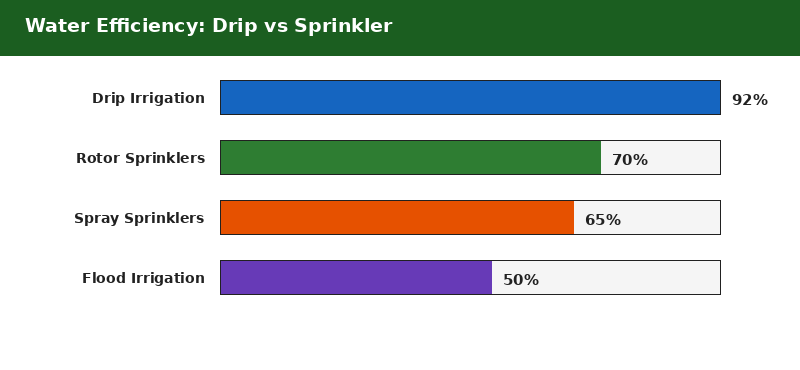
Sprinklers spray water through the air. On a hot day with any breeze, you’re losing 20 to 30 percent of that water before it even hits the ground. I measured it once on a 95-degree afternoon in Fresno. Pressure at the main line was 55 PSI, sprinkler heads were rated for 2.5 GPM each, and we were losing nearly a third of the output to wind drift and evaporation.
Drip systems put water directly at the root zone. Efficiency runs 90 to 95 percent. That’s not a brochure number. That’s what I see on water meters when clients switch over. The difference shows up in your bill the first month.
A typical quarter-acre landscape on sprinklers in central California uses about 1,200 to 1,500 gallons per watering cycle during summer. Same property on drip? 600 to 800 gallons. The math adds up fast when you’re watering three times a week from June through September.
What Drip Gets Right
Water goes exactly where you want it. No overspray onto sidewalks, no runoff down the driveway, no watering the fence line. The emitters deliver 0.5 to 2 gallons per hour depending on the type you pick. That slow delivery means the soil actually absorbs the water instead of letting it pool on top.
Weeds drop off significantly too. When you’re only watering your plants and not the bare dirt between them, weed seeds don’t germinate nearly as much. I’ve had clients tell me they cut their weeding time in half after switching.
Drip also plays nice with uneven terrain. Sprinklers on a slope are a headache. Water pools at the bottom while the top dries out. Drip tubing follows the contour and the slow release rate gives water time to soak in even on a grade.
Pressure requirements are lower too. Most residential drip systems run fine at 15 to 30 PSI with a pressure regulator. A typical sprinkler zone wants 30 to 50 PSI minimum to throw water properly. If you’re on a well with marginal pressure, drip solves problems sprinklers create.
Where Sprinklers Still Win
Lawns. I’ll say it plainly: you cannot drip-irrigate a lawn effectively. The root zone is too shallow and uniform. Subsurface drip for turf exists, but it’s expensive and finicky. If you’ve got grass, you need sprinklers or you need to rip out the grass.
Sprinklers also win on coverage of large open areas. A single rotor head can cover a 30 to 50 foot radius. To get the same coverage with drip, you’d be running hundreds of feet of tubing with emitters every 12 to 18 inches. The labor math flips at some point.
Initial cost can be lower too, at least for basic spray heads. A decent pop-up spray head runs $3 to $8. A quality drip emitter with stake and quarter-inch tubing is about $1.50 to $3 per plant. But the drip system adds up because you need more of them and the main line runs longer.
Real Numbers From the Field
Let me give you a breakdown from a job we did last spring in the Central Valley. Half-acre residential lot, established landscaping mix of shrubs, perennials, and a small lawn section.
Drip conversion for the shrub beds (roughly 3,000 square feet): materials came to $420 using half-inch poly tubing, 120 emitters, a pressure regulator, and a 150-mesh filter. Labor was two guys for a day and a half. Call it $1,200 all in.
Rotors for the lawn section (2,000 square feet): $180 in heads and pipe, half a day of labor. Maybe $500 total.
But here’s where the comparison tips. The client’s July water bill before the conversion was $187. After the drip retrofit, it dropped to $112. That’s $75 saved in a single summer month. The drip portion of the install pays for itself in under two summers of water savings alone.
Maintenance Reality Check
Drip systems need more looking after. Emitters clog. Rodents chew tubing. Someone steps on a quarter-inch line and it pops off the barb. I tell my clients to walk their drip zones once a month during watering season and check for dry spots, leaks, or plugged emitters.
Sprinklers are more forgiving in some ways. You spot a broken head because water’s shooting ten feet in the air. But they have their own issues. Nozzles wear out over time and start throwing uneven patterns. Heads get knocked out of adjustment by mowers and foot traffic. A sprinkler zone with one bad head can waste 200 to 300 gallons per cycle without looking obviously broken.
Drip repairs are usually simpler once you learn the basics. Tubing and fittings are push-together. A plugged emitter is a $0.50 fix. Sprinkler heads need digging, sometimes cutting and gluing PVC. Not hard, but messier.
What the Studies Say
The University of California Cooperative Extension ran drip-versus-sprinkler trials on vegetable crops over five growing seasons. Drip consistently used 35 to 40 percent less water with equal or better yields. Their tomato trials showed 38 percent water savings and a slight yield bump because soil moisture stayed more consistent.
A 2023 survey from the Irrigation Association found that homeowners who switched at least half their landscape to drip reported average water bill reductions of $22 per month during peak season. That’s across all climate zones in the US. Hot, dry regions saw bigger savings. Humid areas with regular rain saw less.
When You Should Run Both
Most of the properties I design now use a hybrid approach. Drip on everything except the lawn. It’s not about being a purist. It’s about matching the tool to the job.
Put your trees and shrubs on drip zones. Perennial beds, drip. Vegetable gardens, definitely drip. Keep sprinklers for grass and large groundcover areas where point-source watering doesn’t make sense.
A typical controller these days handles both types on separate zones without any trouble. You run the drip zones longer at lower flow. You run the sprinkler zones shorter at higher flow. Same controller, same timer, different programming.
Installation Tips From Someone Who’s Fixed a Lot of Mistakes
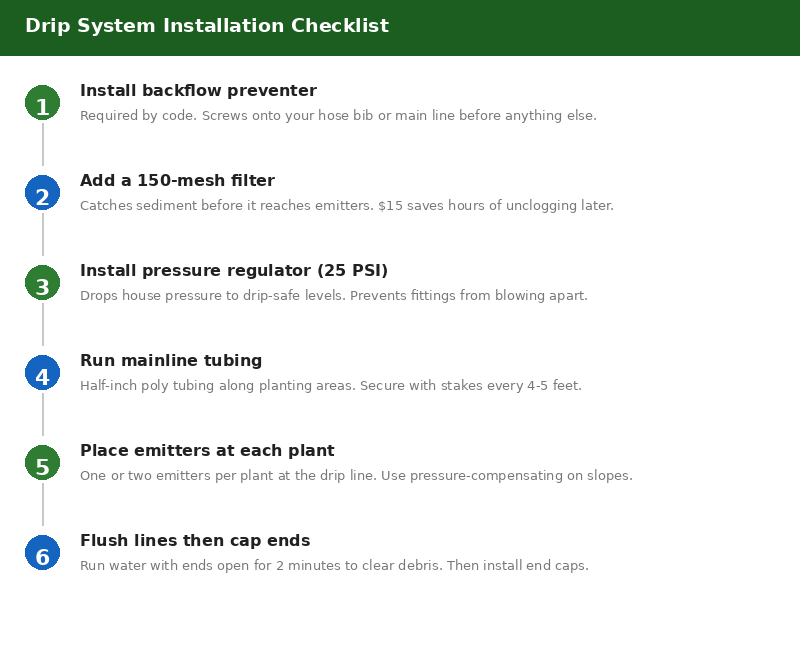
Filter before you run anything. I don’t care if you think your water is clean. A 150-mesh filter adds $15 to your materials cost and saves you hours of unclogging emitters later. Put it right after the backflow preventer.
Pressure regulation matters more than most people realize. If your house pressure is 60 PSI and you don’t regulate down to 25 PSI at the drip zone, your emitters will spit fittings off the tubing within a season. I’ve fixed that exact problem on at least 20 systems that somebody else installed.
Use pressure-compensating emitters if you’re working a slope or a long run. They maintain consistent output from 15 to 50 PSI. Non-compensating emitters at the start of a 200-foot run will put out twice as much as the ones at the end if there’s any elevation change. You’ll have wet spots and dry spots and it’ll drive you crazy trying to figure out why.
Flush the lines before you cap them. Run water through the main line with the ends open for a couple minutes before you put the end caps on. Construction debris, dirt, and little bits of plastic from cutting tubing will all wash out instead of lodging in your first emitter.
The Bottom Line
If you’re watering anything other than a lawn, drip wins on water efficiency, plant health, and long-term cost. The upfront install is a bit more labor, but the payback in water savings usually hits within two to three growing seasons.
That doesn’t mean sprinklers are obsolete. They’re the right tool for turf and large uniform areas. Just don’t default to them for everything because they’re what you’re used to seeing.
I’ve watched enough water bills to know: the system that puts water where the roots actually are, rather than spraying it into the wind, wins every time.