Whatsapp:+86 17852301313 Email:tinghe.lv@yimaotomg999.com


Subsurface Drip Irrigation: 30 Years of Data on Water Savings and When It’s Worth the Cost

Roughly 70% of the world’s freshwater goes to agriculture. And depending on the method, up to half of that never touches a root. It evaporates. It runs off. It sinks past the root zone into groundwater that nobody pumps back up. If you were running a factory that wasted 50% of its raw material, you’d shut it down. In farming, we call it Tuesday.
That gap between what we pump and what crops actually use is where subsurface drip irrigation has been making its case for three decades. The question worth asking is not “does SDI work?” but “when is it actually worth the money?” The answer gets more interesting than the sales brochures admit.
What subsurface drip actually is (and isn’t)
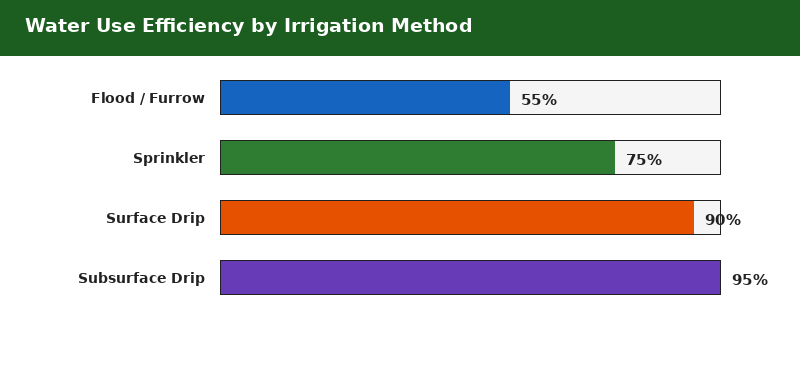
Most people can picture surface drip: black polyethylene tubing snaking along crop rows, emitters dripping water onto the soil surface. Subsurface drip buries that same tubing 12 to 18 inches underground, usually at installation and left there for years. The water goes directly into the root zone. No surface evaporation. No wind drift. No runoff.
It is not the same as burying regular drip tape. SDI tubing has physical root barriers built into the emitter, usually with Treflan or copper sulfate impregnated in the plastic. Without those, roots will find the water source and clog everything within a season. It also runs at lower flow rates (0.16 to 0.40 gallons per hour per emitter) compared to surface drip. The goal is slow, deep saturation, not quick wetting.
Kansas State University has been running SDI trials since 1989 at their Northwest Research-Extension Center in Colby. That is about as long-term as field data gets in this space. Their findings over 15 continuous years of corn production are the closest thing to settled science on this topic.
Thirty years of data, boiled down
The K-State numbers keep surfacing because nobody else has comparable duration. Over 15 years of continuous corn under SDI in western Kansas, the research group reported water savings of 35 to 55 percent compared to center pivot sprinklers. That is not a typo. SDI used roughly half the water to produce the same or better yields.
Yield differences were not trivial either. SDI plots averaged 25 percent higher corn yields than pivot-irrigated comparison plots over the study period. Part of that is timing: you can spoon-feed water exactly when the crop needs it during tasseling and grain fill, without waiting for a pivot to make a full pass. Part of it is fertility. SDI lets you fertigate precisely, putting nitrogen directly into the root zone rather than broadcasting it and hoping rain moves it down.
The Texas High Plains tell a related story. The Ogallala Aquifer under the Panhandle has been dropping 1 to 3 feet per year in heavily irrigated counties. Some areas have lost more than 50 percent of saturated thickness since the 1950s. That reality forced a wave of SDI adoption that produced its own data set. Texas A&M AgriLife Extension documented cotton growers who cut water use by 40 percent while maintaining lint yields after switching from furrow irrigation to SDI. The economics shifted from “can we afford to install SDI?” to “can we afford not to?”
In California, the Sustainable Groundwater Management Act (SGMA) of 2014 triggered a similar conversion. Almond growers in the Central Valley who replaced flood irrigation with micro-irrigation, including SDI, reported 30 percent water savings on average according to UC Cooperative Extension surveys. For a crop that uses roughly 3 to 4 acre-feet per year, that is real money when water districts start enforcing pumping allocations.
The economics: when the numbers work
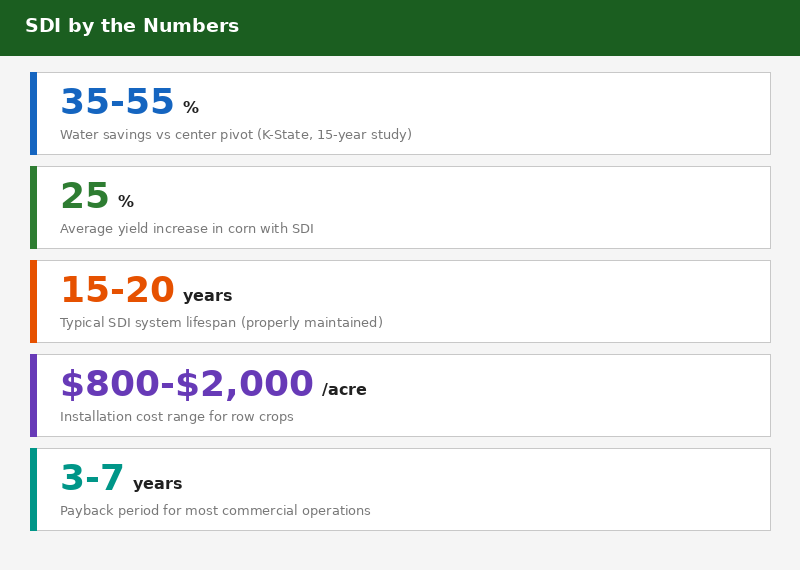
Let’s talk dollars. SDI installation for row crops runs $800 to $2,000 per acre depending on spacing, soil type, and whether you need new filtration and pumping infrastructure. For high-value permanent crops like almonds or vineyards, you are looking at $2,000 to $4,000 per acre. Those are upfront costs that land hard on a balance sheet.
The payback is in three buckets: water savings, yield increases, and input efficiency. Water savings translate directly to lower pumping costs. If you are pumping from 400 feet in the Texas Panhandle, energy is a major line item. Cut water use by 40 percent and your electric bill follows. Yield increases add revenue. Fertilizer efficiency through fertigation cuts input costs. Most operations hit full payback in 3 to 7 years.
There is also a lifespan advantage that gets undercounted in simple payback math. Properly installed SDI with good filtration and regular maintenance lasts 15 to 20 years. Some K-State plots have been running the same tubing for over 25 years with no replacement. Surface drip tape typically lasts 1 to 5 seasons before UV degradation and physical damage force a swap. The longer the system lasts, the better the economics look.
Government programs sweeten the deal. The NRCS Environmental Quality Incentives Program (EQIP) offers cost-sharing that can cover 50 to 75 percent of SDI installation costs depending on the practice code and your location. Some groundwater conservation districts in Texas and Kansas add their own incentives on top. If you farm in a priority watershed, the effective cost to you might be half of sticker price or less.
Where SDI fails (and nobody likes to talk about it)
Here is the part the equipment vendors tend to skip. SDI has real failure modes, and they are expensive when they happen.
Rodents. Gophers and ground squirrels love buried drip lines. They chew through the tubing to get at the water. One gopher can destroy hundreds of feet of lateral line in a season. Repairs mean digging, splicing, and hoping you found every hole. Some growers report losing entire zones to rodent damage within the first three years. There are mitigation strategies: deeper burial, wire mesh barriers, trapping programs. None are foolproof.
Water quality is another hard constraint. SDI emitters have tiny flow paths (typically 0.5 to 1.0 millimeter). If your water carries high iron, manganese, or calcium carbonate, you will fight precipitation inside the lines constantly. Acid injection helps but adds cost and labor. If your water source is a surface canal with high sediment load, you need serious filtration — sand media filters at minimum — which adds thousands to the upfront cost and requires daily maintenance during irrigation season.
Soil type matters more than people admit. In very sandy soils with low water-holding capacity, the small wetting front from SDI emitters may not spread far enough laterally between emitters. You get dry stripes. In heavy clay soils that crack when dry, the cracks can create preferential flow paths that send water straight down past the root zone before it spreads horizontally. Neither scenario is a dealbreaker, but both require careful emitter spacing and irrigation scheduling adjustments that are easy to get wrong in year one.
Crop rotation can also clash with SDI. If you install lines at 13 inches deep for corn, then switch to wheat or soybeans that root shallower, you may need surface irrigation to get the crop established before roots reach the buried drip zone. That means maintaining two systems or accepting lower early-season vigor. Not catastrophic, but not nothing.
I am not arguing against SDI. For many operations, it is the right call. But the decision should survive contact with the worst-case scenario, not just the brochure math.
What this means for you (without the fluff)
If you are farming in an area where water is getting scarcer or more expensive — which describes a growing fraction of irrigated acreage globally — SDI deserves a hard look. Start with your local extension office. Most land-grant universities have irrigation specialists who can pull up data specific to your soil type, crop, and water source. K-State, Texas A&M, UC Davis, and Nebraska all have active SDI research programs and field days where you can see systems in the ground.
For smaller-scale growers and serious gardeners, the economics shift. A $2,000 per acre installation is hard to justify for a market garden. But surface drip with mulch achieves many of the same benefits — 90 percent efficiency, targeted watering, reduced weed pressure — at a fraction of the cost. You lose the multi-year lifespan and the subsurface advantage, but you gain flexibility and simplicity. For most operations under 5 acres, surface drip is the pragmatic choice.
Run the numbers on your own operation. If your water costs are low, your aquifer is stable, and your yields are already where you want them, SDI might be a solution looking for a problem. If you are watching well levels drop every year and your pumping costs keep climbing, the math probably works. Get the data. Talk to growers who have done it. Visit a field day. The research is solid. The decision is yours.