Whatsapp:+86 17852301313 Email:tinghe.lv@yimaotomg999.com


Smart Irrigation Controllers: Do They Really Save Water? Here’s What the Numbers Say

Smart Irrigation Controllers: Do They Really Save Water? Here’s What the Numbers Say
I’ve been installing irrigation systems for years, and I’ll be honest: I was skeptical about smart controllers at first. Another gadget promising to solve everything. But the data’s hard to argue with, and I’ve seen enough installs now to know when they work and when they don’t.
What a smart controller actually does
A standard irrigation timer is dumb. You set it to run 20 minutes every other day, and it runs 20 minutes every other day whether it just rained two inches or not. A smart controller adjusts. It pulls local weather data or reads a soil sensor and says “skip tomorrow, the ground is still wet” or “run longer today, we hit 98 degrees.”
That’s really the whole thing. It’s not magic. It’s a timer with a brain.
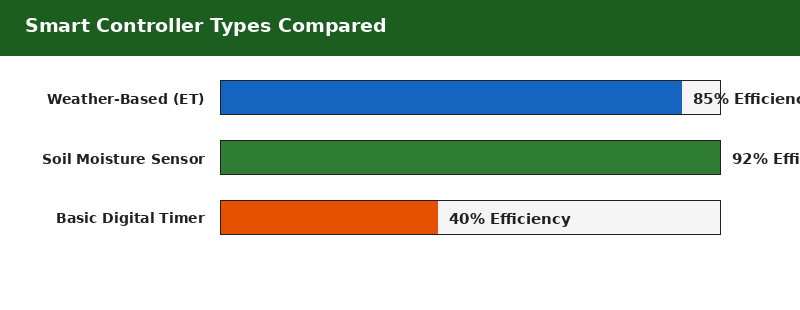
Two main types: weather-based controllers (evapotranspiration, or ET controllers) and soil moisture sensor controllers. ET controllers use local weather data from the internet. Soil moisture sensors stick a probe in the ground and measure actual water content. Both work. I’ve installed both and they each have their place.
The EPA numbers that got my attention
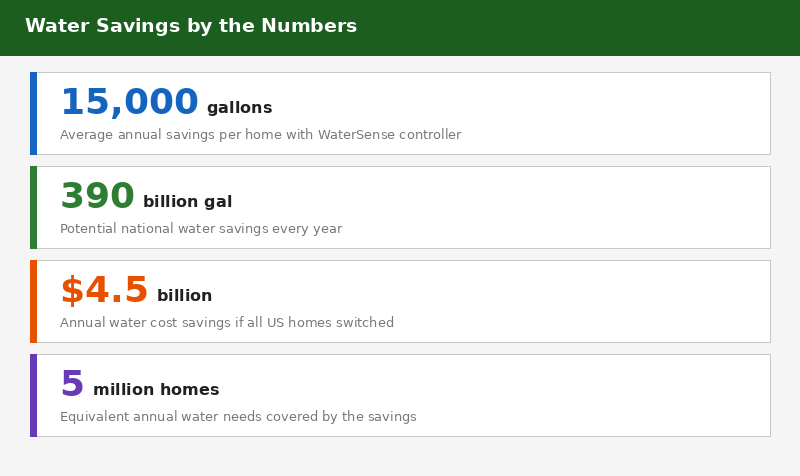
The EPA’s WaterSense program has actual data on this. A WaterSense-labeled smart controller saves the average home up to 15,000 gallons of water a year. Fifteen thousand. That’s a lot of water not running down the driveway.
If every home in the US with an automatic sprinkler system had one of these installed and set up right, the EPA says we’d save $4.5 billion in water costs and 390 billion gallons of water annually. That’s equal to the annual household water needs of about 5 million American homes.
I’ve tracked a few of my own residential installs. One customer in Phoenix went from 18,000 gallons a month in summer to just under 12,000 after I put in a Rachio controller and set up the zones properly. That’s roughly $25 to $35 a month off their water bill depending on the tier they’re in. It adds up fast.
Weather-based vs soil moisture: which one should you get?
Weather-based controllers are easier to install. You swap out the old timer, connect to WiFi, enter your zip code and zone details, and the controller pulls forecasts and historical ET data. Brands like Rachio, Rain Bird, and Hunter Hydrawise all do this. Most run $150 to $280 for a residential unit.
Soil moisture sensors add a physical probe in the ground. Brands like Irrometer make the Watermark sensor. You bury it in a representative spot in the yard, wire it back to the controller. The sensor reads soil tension in centibars. Dry soil reads higher (like 60 to 80 cb for clay), wet soil reads low. You set thresholds: when it hits 40 cb, allow watering; below 25, skip it.
The sensor route costs more upfront. The sensor itself is $35 to $80 plus the labor to trench and bury the wire properly. But in my experience they’re more accurate for large landscapes where the microclimate might not match what the weather station three miles away says.
For a typical suburban lawn, a weather-based controller is the sweet spot. For a property with lots of tree cover or steep slopes where runoff is an issue, I’d lean toward soil moisture sensors.
What the install actually looks like
If you already have an irrigation timer on the wall, swapping to a smart controller is about an hour of work for most people. Kill the power at the breaker, pull the old timer off the mounting plate, wire the new controller to the same zone wires and common, connect the 24V transformer, power it back on. Most smart controllers have an app that walks you through the rest.
The hardest part is usually the WiFi connection if the controller is in the garage or a basement mechanical room. I’ve had to add WiFi extenders at a few installs. The Rachio 3 and Hydrawise units both have decent antennas. Hunter’s outdoor-rated Hydrawise can mount outside the garage closer to the router if that’s an issue.
For new construction or full system replacements, I spec the controller during the design phase. A 6-zone smart controller costs about $130 to $200. The labor is the same as installing any controller. The payback period is usually under two years.
Does the ROI actually work out?
Let’s run some simple math. Average US household spends somewhere between $500 and $1,200 a year on outdoor water depending on climate and lot size. If a smart controller cuts that by 20 to 30 percent, you save $100 to $360 a year. The controller costs $150 to $280. Even without professional installation, you’re looking at payback in 6 to 18 months.
I had a client in Austin who installed a Hydrawise controller in March. By September, his water use was down 34 percent compared to the same period the year before. His water utility also gave him a $75 rebate for installing a WaterSense-labeled controller. A lot of municipalities do this. Check your local water district before you buy.
Mistakes I see people make
Biggest one: skipping the zone setup. A smart controller can’t do its job if you don’t tell it what each zone waters. Grass needs different scheduling than shrubs, which are different from drip zones. Spend 20 minutes setting up zone types, soil type, slope, sun exposure. The app makes it easy but people skip it.
Second: mounting the soil moisture sensor in the wrong spot. If you bury it in a dry corner where sprinklers barely reach, the controller will overwater everything else trying to satisfy that one sensor reading. Put the sensor in the zone that dries out first, or use multiple sensors for larger systems.
Third: not adjusting seasonally even with a smart controller. Most of these controllers self-adjust but you still want to check the schedule once a season. I’ve seen ET controllers run too long in spring because the historical averages lagged an unusually wet year.
Fourth: ignoring maintenance. Smart controllers don’t fix leaks, clogged nozzles, or misaligned heads. Walk your zones once a month during the watering season. It takes 10 minutes and catches problems before they turn into dead plants or a $400 water bill.
Bottom line
If you’ve got an automatic sprinkler system and you’re still using a mechanical or basic digital timer, a smart controller is one of the few irrigation upgrades that actually pays for itself. The numbers from the EPA are real. The savings I’ve tracked on my own installs line up.
At $150 to $280 for the hardware, with rebates often knocking $50 to $150 off that, and water savings of 15,000 gallons a year on average, it’s a straightforward call for most homeowners.
Just do the zone setup. And check it once a season. The controller is smart but it still needs a human who knows where the sprinklers are actually hitting.